There is a moment in mid-summer when you lift a super frame and it feels almost too heavy to hold in one hand. The comb is white-capped, the bees are calm, and the honey is finally ready to take. What happens over the next hour or two decides whether that harvest is a clean, gentle job or a sticky afternoon that sets the colony back a fortnight. The difference is rarely down to expensive kit. It comes down to timing, patience, and knowing when to stop.
Check that the honey is ready — and that the bees are, too
Honey is ripe when the bees have capped it. Nectar that is still open and watery has too much moisture in it, and it will ferment in the jar. A sensible working rule is to wait until eight frames in ten are capped before you take a super off. If you want to be more certain, hold a frame horizontally over the hive and give it a sharp downward flick: ripe honey stays put, while unripe nectar sprays out.
Before you lift a single super, look inside the brood box. Pull a frame or two from the edges of the brood nest and check what is stored there. A colony that has just swarmed, requeened, or is struggling with varroa is not a good candidate for a full harvest, however good the supers look.
And take honey only from supers. Brood frames stay with the bees: the wax is darker, the honey is mixed with brood rearing, and removing it takes food straight out of the nest.
Clearing the bees without drama
You want the supers empty of bees, and you want that to happen calmly. Three approaches work well.
- Bee escape boards. A rhombus or Porter escape set in a board under the super, left overnight. The bees move down to the brood nest and cannot find their way back up. Fit it in the evening, collect the super the next morning, and do not leave it on for days — once the flow stops, the bees need access to those combs again.
- A brush. A soft bee brush, or a handful of long grass, moved downwards in one confident stroke. Quick and useful for the last few frames, but it does agitate them, so avoid it during a dearth when robbing is likely.
- A blower. Effective on a big harvest, though noisy and best done well away from the apiary entrance so you are not dropping bees onto the landing board.
A few stragglers on a frame are nothing to worry about. Tap the bottom bar gently over the open hive and they will drop back in. What matters more is speed: work from a closed box, keep supers covered, and get them indoors before wasps and other colonies notice. Robbing starts in minutes on a warm, quiet afternoon.
Uncapping: shave, do not sculpt
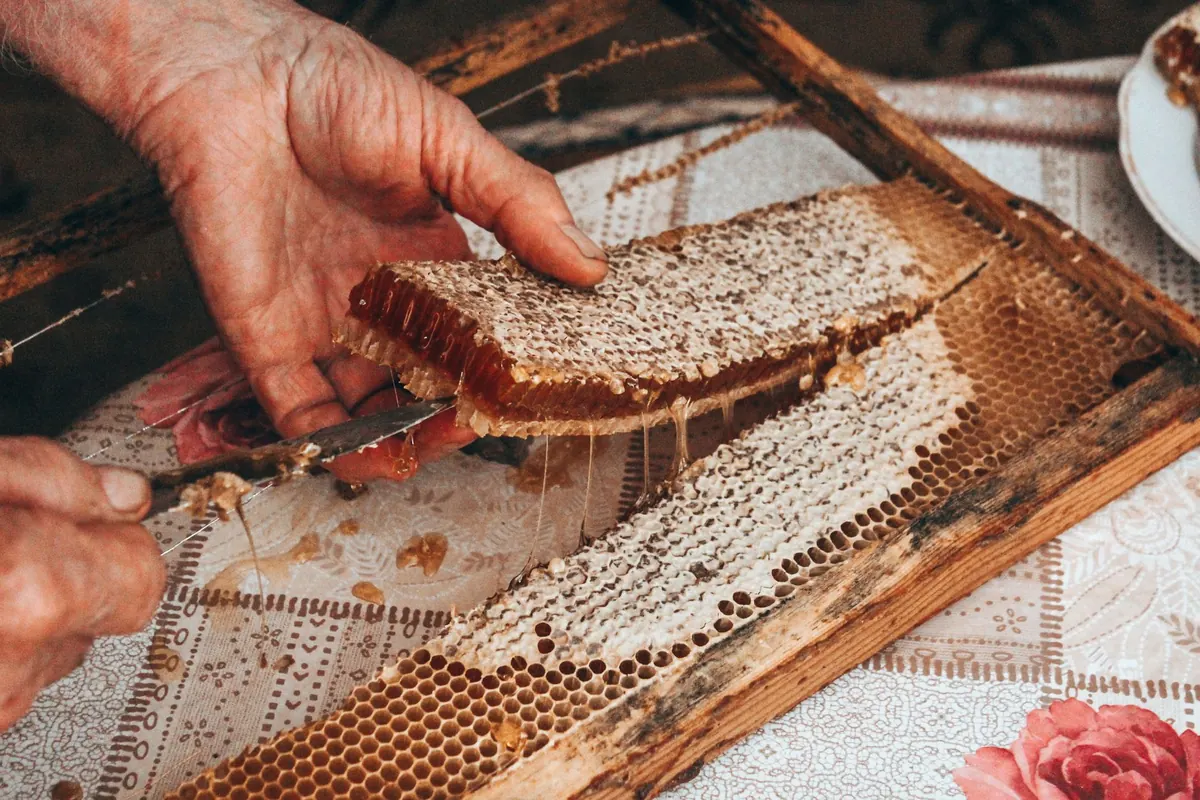
Set the frame on an uncapping tray or a large baking tray and cut the brace comb away first with your hive tool. Then run a warmed uncapping knife along the comb in long, steady strokes from the top bar downwards, tilting the frame slightly so the caps fall clear.
The aim is to take the lids off, not to level the comb. Go too shallow and half the cells stay sealed; go too deep and you lose honey and leave the bees with damaged wax to rebuild. For uneven or foundationless comb, an uncapping fork or a scratch tool gets into the dips that a knife skips over.
Let each uncapped frame drain on the tray for a minute while you pick up the next one. Over a dozen frames that is a worthwhile amount of honey, and it keeps your floor cleaner.
Extracting: slow first, then fast
Honey flows best at around 20–25°C. Below about 15°C it moves like treacle and you will be spinning for a long time. A warm room, not a hot one, is what you want.
Load the extractor with frames of similar weight, set opposite each other so the drum stays balanced, then start slowly. A gentle first minute lets the honey leave the outer cells before the comb can slump; starting at full speed with a heavy frame tears out the midrib and leaves you with broken wax in the honey. Once the frames feel lighter, build up the pace. With a tangential extractor, spin one side, turn each frame, and spin the other.
Keep everything that touches the honey clean and food-grade — extractor, buckets, sieves, hands. Warm water and a little washing-up liquid, rinsed thoroughly and dried, is enough. Strongly scented cleaners have no place near a honey harvest.
Filtering and settling
Pour through a coarse sieve first to catch wax and bee parts, then a finer one. Warm honey passes through easily; cold honey does not, and heating it hard to speed things up costs you aroma and character. If you must warm it, keep it gentle and well below anything that would cook it.
Then let it settle. A settling tank left overnight, or for a couple of days in a cool room, lets air bubbles and fine wax rise to the top and any remaining sediment sink. Skim the foam, then jar from the tap, leaving the last inch behind. Honey is hygroscopic, so keep lids on and store it somewhere dry; food-grade buckets with tight lids, labelled with the date and the hive, will keep perfectly well.
Leaving the colony enough to survive
This is the part that separates a good harvest from a damaging one. A colony that goes into winter light will struggle, and you will spend spring feeding instead of enjoying the crop.
Heft the hive from behind with two fingers under the floor. If it lifts easily, they are short. A common rule of thumb for a strong colony in most of the UK is somewhere in the region of 15–20kg of stores to see it through to spring, but hive type, site, shelter and the bees themselves all change that figure, so treat it as a starting point rather than a target.
If stores are thin, feed thick syrup in early autumn, and keep an eye on weight through winter with fondant as a backup. Never feed honey of unknown origin, and never leave a super of syrup on a hive you intend to harvest from later.
The harvest, in order
- Check brood box stores before you take anything.
- Confirm the combs are properly capped.
- Fit an escape board the evening before.
- Move supers indoors in a closed box, promptly.
- Uncap over a tray, shaving rather than cutting deep.
- Spin slowly, then faster, keeping the extractor balanced.
- Filter twice, settle overnight, then jar.
- Heft the hive afterwards and feed if it feels light.
Take less than you could. A colony left with a full super and a good brood nest will go into winter strong, build early in spring, and give you a bigger crop next year than one you stripped in July. The best beekeepers are the ones who stop a frame early.
Photo: Eva Al / Pexels